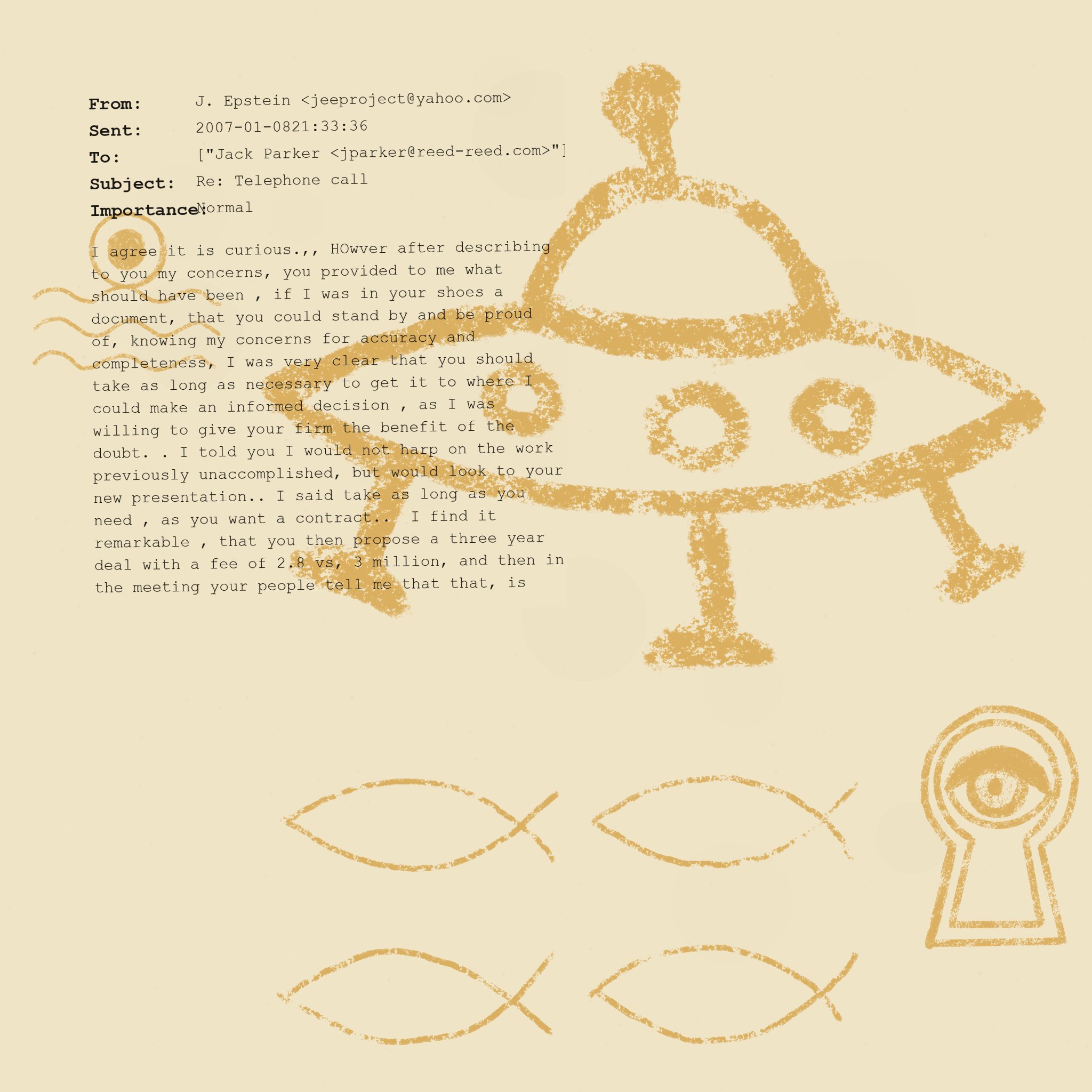
A real Estate-of-Epstein email composited with hand-drawn glyphs, tinted in warm sepia gold (a rare ~1% trait combination).
Red yarn connects the nodes like a detective board, drawing on, holding, then erasing. One of seven motion variants.
The complete DOJ Epstein release — 2,522 PDFs, 2,795,365 page JPGs, 421 GB — mirrored to Cloudflare R2 and self-hostable from a published manifest.
Conversational Oracle, full-text reference search, document cache, mirror guide. Every page is its own URL.
Each piece is a real Epstein-estate email rendered with hand-drawn glyph language. Deterministic from seed.
Browse all 1,000 static pieces at epstein-onchain.vercel.app · 200 motion samples at /animated
| Supply | 7,777 |
| Mint price | 0.0169 ETH per piece |
| Primary raise | 131.4 ETH |
| Liquidity allocation | 10% (~13.1 ETH) seeded into the $FILES/ETH pool at launch |
| Operations + creator | 90% (~118.3 ETH) |
| Chain | Ethereum mainnet |
| Standard | ERC-721 with animation_url (motion variants) |
Six orthogonal trait dimensions per piece: glyph palette, density tier (monumental / couple / scatter / constellation), glyph count, redaction intensity, grail (none / ufo / gold / prism / ufo+gold / ufo+prism), and motion (static plus seven animated variants — amoeba, glitch, party, conspiracy, ink-bleed, ghost, burn).
Provenance is deterministic. Anyone with the seed can re-derive the piece, and the underlying Bates ID resolves to the real DOJ document on R2.
A native ERC-20 distributed at the snapshot following mint completion. 10% of mint proceeds (~13.1 ETH) seed the $FILES/ETH liquidity pool at launch.
| Airdropped to NFT holders | 80% of $FILES supply |
| Paired into LP at launch | 10% (alongside ~13.1 ETH) |
| Reserved (ops, marketing, future-chapter airdrops) | 10% |
$FILES has two explicit functions:
The Renegade Art Guild makes no representation about EOT's price, yield, or trading behavior. Those are market outcomes outside our control. $FILES is not an investment contract. What the market does with it is not our doing.
No governance. No DAO votes. No profit guarantees.
The flagship $FILES utility: holders can burn a defined amount of EOT to permanently inscribe a carbon copy of their NFT piece directly onto a base-layer chain — as an Ethscription (calldata-inscribed on Ethereum mainnet) or a Bitcoin Ordinal (inscribed on Sat-0 BTC).
The Renegade Art Guild's deepest promise — we won't forget — gets enforced by the most preservation-resistant infrastructure humans have built.
The entire stack is archive-agnostic. Page extraction, R2 mirror, FTS5 search, conversational Oracle, generative mint pipeline — every layer works for any document release, not just Epstein.
Each gets its own mint, its own Oracle, its own token, and its own Renegade Art Guild chapter — built on the same open infrastructure.
Public Epstein archives until now have been PDF dumps. Reading any document means downloading it, scrolling through it, citing "see attached PDF p. 47." The Renegade Art Guild pattern makes every page a hot-link, every name a query, every motion a conversation, and the whole archive ungovernable to take down — because anyone can mirror it in an afternoon.
The mint funds the next chapter. $FILES distributes ownership to the researchers, holders, and archivists who showed up first.